
Artificial Ignorance
The Sun-Times' fake-books pratfall exposes the perils of relying on AI and invites a closer look at the 'premium issue' scam

5-22-2025 (issue No. 194)
This week:
Artificial Ignorance — Here’s hoping that the embarrassing news about how the use of AI infected a Sun-Times Sunday supplement will finally wake the public to the sleazy way newspapers’ corporate owners use these supplements to rake in extra money
News and Views — Hot takes, fully baked
Meet ‘The Biblioracle’ — An interview with the Tribune’s freelance book columnist
Land of Linkin’ — Where I tell readers where to go
Squaring up the news — Where Charlie Meyerson tells readers where to go
Quotables — A collection of compelling, sometimes appalling passages I’ve encountered lately
Quips — The winning visual jokes and this week’s contest finalists
Good Sports — On Caitlin Clark and Angel Reese
Green Light — Reader Scott Tepper recommends you check out the vocal stylings of the late Eva Cassidy
Programming notes: There will be no Picayune Plus next Tuesday because Monday is Memorial Day. Also, a reminder that, with no hard feelings, Mary Schmich has chosen to no longer be a regular contributor to the Picayune Sentinel.

Will the embarrassing news about the Sun-Times ‘premium edition’ finally wake the public to this sleazy scam?
It made international news when a supplement to last Sunday’s Chicago Sun-Times contained an AI-generated “Summer reading list for 2025” in which 10 of the featured 15 books did not exist. Other AI-generated or AI-assisted stories in the supplement reportedly quoted experts who do not not exist.
On social media, reporters and editors at the Sun-Times have expressed mortification and embarrassment since a spectacular blunder like that undercuts the reputation of the newspaper. The newsroom union’s statement said members were “horrified by this slop syndication,” realizing that many readers won’t understand that the 64-page “Heat Index” summer entertainment guide was written by a freelancer and provided to the paper by King Features, a unit of Hearst Newspapers.
Yes, someone at the Sun-Times (and the Philadelphia Inquirer, which ran the errant supplement last Thursday) should have given the supplement a once-over given that readers would naturally assume that the articles have at least the imprimatur of the newspaper, but staffing is tight these days, and at some point, time-pressed editors have to trust freelancers to be fair and accurate.
King Features has severed relations with Marco Buscaglia, the Chicago-based writer who submitted the AI nonsense for “Heat Wave” and boasted of his “crack research skills along with his unwavering ethics” on his personal website, which he took private after this scandal broke. The Sun-Times and other outlets have reported that Buscaglia has taken full ownership for what happened:
Buscaglia said he … wanted to assume full responsibility for what happened, which exposed the Sun-Times and Philadelphia Inquirer to widespread public mockery.
“Stupidly, and 100% on me, I just kind of republished this list that (an AI program) spit out,” said Buscaglia, a longtime journalist. “Usually, it’s something I wouldn’t do.
“I mean, even if I’m not writing something, I’m at least making sure that I correctly source it and vet it and make sure it’s all legitimate. And I definitely failed in that task.”
Buscaglia … acknowledged using AI for other stories in addition to the list of books and could not guarantee he fact-checked those articles completely either, saying, “At this point, I’d expect anything.”
Slate’s Henry Grabar was a bit sympathetic:
Buscaglia’s profile is interesting because he’s not a tech guy trying to automate journalism jobs. He’s a 56-year-old media lifer with two writing degrees trying to automate his own freelance job, using AI to maintain an impossible human workload of low-paid gigs. He’s the victim of the previous downward spiral of paid writing jobs (thanks to the decline of ad dollars) turned perpetrator of the current downward spiral of paid writing jobs, wielding (large language models) to perform a convincing impression of the 25-year-olds who would have crafted the summer heat special section in 1997, and distorting unscrupulous bosses’ sense of what they can get for their money.
Grabar concludes that the eruption of umbrage over “Heat Wave” “is a sign of something ending—a last gasp from the era of the diligent, human reader who can tell the difference between a real book and a fake one.”
One possible silver lining here is that it will remind journalists that — for now, anyway — AI is not necessarily a reliable partner for a writer, and that everything it generates must be double-checked against reality. And it will spur publishers and editors to invest the necessary time and money into making such double checks.
Another possible silver lining is that it might inspire subscribers to revolt against the sneaky practice of charging readers on the sly for these “premium” giblets stuffed into their papers.
“Subscribers will not be charged for this premium edition,” says the Sun-Times apologia.
I can imagine Sun-Times subscribers reading this and asking themselves, “What the hell? They were going to charge me extra for an insert I didn’t ask for and probably wouldn’t read?”
Yes, they were! Here is from the fine print at the Sun-Times website (weird, Trumpian capitalization theirs):
All Print Subscriptions may include up to eleven (11) Premium Editions per year. For each Premium Edition your account will be charged an additional fee of at least $3 in the Billing Period the edition is published. Each such additional fee will be deducted from your Subscription payment, which will shorten the length of your Billing Period.
The Philadelphia Inquirer also levies a charge for these extra inserts — a customer service representative told me that the charge is equal to whatever the subscriber happens to be paying for the Sunday paper.
Both papers allow subscribers to permanently opt out of paying for these products by calling the customer service line — 888-848-4637 for the Sun-Times.
The Tribune’s fine print about this sneaky charge is way more appalling:
Your subscriptions may include up to 15 premium issues per year. For each premium issue, your account balance will be charged an additional fee up to $15.99 in the billing period when the section is published. This will result in shortening the length of your billing period.
The number of these “premium issues” per year has risen from “up to 12” to “up to 15,” and the price per “premium issue” has shot from $7.99 to $15.99 since just 2022. The price is never mentioned on the cover, and the inserts are never labeled as “premium,” which is yet another layer of deception.
The Tribune Content Agency refers to this practice as “a tested model that generates significant fresh revenue.”
Subscribers can opt out of paying the Tribune this additional fee by calling 312-546-7900 and navigating the phone tree, but the opt-out lasts only six months at a time. Why not forever? Believe me, I’ve asked many times and never gotten the answer (which is obviously “because we need the money and we know people will forget to opt out”).
Would that the newsroom unions spared a little indignation for this sneaky way of exploiting subscribers.

Last week’s winning quip
My boss arrived at work in a brand new Lamborghini. I said, “Wow, that’s an amazing car.” He replied, “If you work hard, put all your hours in and strive for excellence, I’ll get another one next year” — @weekdayjokes
Here are this week’s nominees and the winner of the Tuesday visual-jokes poll. Here is the direct link to the new poll.

News & Views
News: President Donald Trump’s Justice Department is investigating Chicago Mayor Brandon Johnson for making “hiring decisions solely on the basis of race” in light of remarks he made over the weekend.
View: For generations, white elected officials favored white job applicants, but were seldom if ever blunt enough to admit it publicly. Johnson, who is Black, made the mistake of bragging about his tendency to favor Black applicants “to ensure that our people get a chance to grow their business” because “we are the most generous people on the planet.”
Speaking at the Apostolic Church of God on Sunday, Johnson said, “One thing I know for sure I have to do over these next two years: Every single dime that our people have been robbed of, I’m going to make sure that is returned two-, three-fold.”
Johnson’s goal — compensating for decades of discrimination with some affirmative action and boasting about it to boost the support he’ll need from Black voters if he is to have any chance at reelection in 2027 — is understandable. His tactic — defiantly playing the race card — is divisive and politically tone-deaf.
News: The Illinois General Assembly is considering measures to phase out plastic shopping bags and foam food containers
View: Yes to banning foam food containers but no to banning plastic shopping bags, which I’m not persuaded are more environmentally friendly than paper bags. Keep the bag tax — heck, raise it a bit — to encourage shoppers to bring reusable bags, but allow retailers to provide plastic bags.

Meet the Biblioracle
I’ve long been intrigued by John Warner’s “Biblioracle” columns in the Sunday Tribune — a clever combination of literary criticism, consumer advice and reflections on the state of publishing. Who is this guy anyway?
I reached out to him, and here is a lightly edited version of our email exchange:
EZ: Where did you grow up and what did your folks do?
JW: I was born April 5, 1970, in Evanston Hospital and grew up in Northbrook. My mother, Sue, founded the Book Bin bookstore in Northbrook when I was a year old, and ultimately co-owned it with a few different partners until just after I graduated from college in 1992. My father, Mike, was a lawyer in Chicago with Seyfarth Shaw. He passed in 2005. My mom still lives in Glenview. I have one sibling, Mike Jr., who is four years older than I am and still lives in Chicago, working as a lawyer just like our pops.
EZ: Where did you go to school and what did you study?
JW: Greenbriar Grade School, Northbrook Junior High, Glenbrook North High School and then the University of Illinois, where I majored in rhetoric, which was really just a fancy name for creative writing. After a couple of years of work post-college, I earned a master’s degree in literature and a master of fine arts in creative writing at McNeese State University in Lake Charles, Louisiana.
EZ: When and how did you start writing the Biblioracle column?
JW: The Biblioracle persona — the person who “tells you what to read based on the last five books you’ve read” — was born as an offshoot of my role as co-color commentator with my friend Kevin Guilfoile in the Tournament of Books, a March Madness-style bracket competition for books instead of basketball. When we’d run out of things to say late in the 2010 tournament, I offered on a whim to recommend a book to anyone who posted in the comments the last five books they'd read. Maybe 150 people asked for recommendations. It took me all day to respond.
In 2011, as a new Printers Row book section was launching, Kevin recommended me to the Tribune’s literary editor, Jennifer Day. The first Biblioracle column appeared in February 2011, and I've been in the paper in one way or another almost every week since.
EZ: How many requests do you typically get for advice from people writing to biblioracle@gmail.com?
JW: In a given week, it's no fewer than two and usually no more than 10, but it varies week to week, and I have no idea why. I serve customers in order of request provided they include both their first name and last initial, their current hometown and their five most recent reads. For the most part, I'll tackle any list, but I do sometimes shift the order of which list goes in which week to make sure there's a variety of recent reads among the requesters. Sometimes, I'm not able to accommodate a request just because the books are too far outside my sphere of knowledge, but that's fairly rare.
EZ: How many papers does the column run in?
JW: Just the Chicago Tribune, and I guess some Tribune-owned papers on occasion. But I've never been syndicated. I was told years ago that that wasn't a thing anymore, and it hasn't been, at least for me.
EZ: What's your process? In other words, how do you read so much, write the column and also hold down a job?
JW: It's evolved somewhat over the years. For the early years of the column, I was teaching college full time as a non-tenure track lecturer at the College of Charleston. I also started writing a weekly blog for Inside Higher Ed, so I would teach pretty much all day on Tuesdays and Thursdays, and use Mondays, Wednesdays and Fridays for writing, grading, class prep, etc. Since 2019, I've been totally freelance and now mostly make my living by speaking at colleges and schools to help others teach writing. So while I could be more flexible with the column, I rarely am. Basically, Monday or Tuesday, I settle on what I'm going to write about. Often, it's a book I'm reading or some bit of book-related news that crossed my transom. I then spend some idle time Tuesday and Wednesday just thinking about my subject, jotting down a couple of thoughts. I draft the column (always 600 words, give or take) on Thursday, sleep on it, then revise and do the recommendations on Friday. I send it to my editor Friday by 5 p.m. to run a week from that Sunday.
Occasionally, there will be some more timely event that throws me off that schedule — most often the passing of a writer I liked — but it's always a deliberate process of thinking and planning followed by a relatively short period of active writing and the revising. Thanks to the thinking/planning, the drafting usually doesn't take much more than an hour of concentrated work. It's one of my favorite activities of the week because it's like I've had a blurry picture of what I wanted to capture rolling around my head for a couple of days and the writing is my chance to bring it into focus and capture what I'm seeing.
Reading isn't a problem because that's just something I do. I read at least a book a week and often am simultaneously reading one nonfiction book and one work of fiction. I get at least 15 pitches for books from publishers every day, so I'm never short of tempting material. I also manage to buy plenty of books every year too.
EZ: What else do you write?
JW: Over the course of my increasingly varied career, I've done a lot of different stuff, including many years writing and editing humor through my association with McSweeney's Internet Tendency. A few years ago when I thought the end of newspapers was nigh, I started a Substack newsletter The Biblioracle Recommends where I do similar things as my Tribune column. This includes giving reading recommendations, but I also range more freely in terms of topics, though I always try to bring things back to books and reading in some fashion. I've published a bunch of books over the years, including a novel (“The Funny Man”) and a collection of short stories (“Tough Day for the Army”), but for the last six or seven years, I've been primarily focused on writing about how I think we could and should better teach writing, including three books, “Why They Can't Write, Killing the Five-Paragraph Essay and Other Necessities,” “The Writer's Practice” and, most recently, “More Than Words: How to Think About Writing in the Age of AI.”
I know folks are worried about students not learning to write anymore, and I'm here to say that this is a challenge we can meet.
EZ: What is your current family situation?
JW: I’ve been married to Kathy Sennello for 25 years as of this August, no kids, two dogs (Quincy and Baxter). Kathy is a veterinarian, and we live in Folly Beach, South Carolina, just outside Charleston.
EZ: Which recent novels are you recommending these days?
JW: Some recent — new in at least the last few years — novels I've been recommending are:
“The Passenger Seat” by Vijay Khurana, a novel about two teenage boys from rural Canada plagued by the inchoate discontent of being young and feeling alien who make some bad choices without truly choosing. It's coming out of the same zeitgeist as recent Netflix sensation “Adolescence,” but because it's a novel and focused on the boys, we get a much more intimate experience.
“The Search” by Michelle Huneven. When I tell people that this is a novel about a Unitarian church in California going through the process of finding a new minister that includes lots of talk about food (including recipes in the back), it sounds boring, but it's warm and charming without being cloying or saccharine. This is what I recommend for people who are looking to escape the present world around them who aren't into outright escapist literature.
”The Book of George” by Kate Greathead. This is a little trickier recommendation in that the title character is sort of a self-sabotaging shithead who is also strangely charming (and at times, charmed), and you spend chunks of the novel wanting to tell him to get his act together. Greathead writes with tremendous clarity, which is not quite the same thing as sympathy.
EZ: Finally. what are your favorite novels ever?
JW: A truly impossible question to answer! At least you asked me for my "favorites," rather than the novels that I think are "the best," which would've tied me up for weeks. I've decided to go with the novels that had the greatest impact on me at the time I read them, privileging that initial experience of the novel as opposed to engaging in hindsight about which books remain my "favorites." It's possible that I may not even like some of these books if I read them now, but I cannot deny their impact on me at the time I read them.
“Bridge to Terabithia” by Katherine Paterson. I would've read this when I was 10 or so years old, and it had a profound effect on my childhood notions of love and grief. It's a book that takes the emotional lives of young people seriously, and I guess I just found it reassuring in that way.
“The Godwulf Manuscript” by Richard B. Parker. This is the first of Parker’s Spenser novels. It was published in 1973, but I would've been maybe 14 when I read it. I grew up in the era where young adult fiction was Judy Blume and S.E. Hinton and not much else, so my mom started giving me relatively safe adult books. Spenser is a Boston private investigator, deliberately modeled on a classic chivalric hero and is a kind of ideal portrait of secure masculinity. He’s a feminist who will also punch out a bad guy if necessary.
“The Girl with Curious Hair” by David Foster Wallace. I read an advance copy of this sent to me by my mom freshman year of college over Labor Day weekend after everyone I knew went home for the holiday. Not a novel, but a collection of short stories grappling with stuff I didn't know people were allowed to write about.
“Oreo” by Fran Ross. The first and only novel written by Ross. It is the smartest funny book I've ever read. Everyone I recommend it to agrees with me.
“The Water-Method Man” by John Irving. This is one of Irving's pre-“The World According to Garp” novels, and it is still the one that gets me to laugh out loud more than any novel I've read. There's a scene where the main character, Fred "Bogus" Trumper, is trying to ski down a mountain in Austria that I cannot get through because the tears of laughter blind my vision.
“The End of Vandalism” by Tom Drury. This one speaks to my Midwestern heritage. A novel of regular people trying to get along even when the world seems aligned against their chances of success.
Land of Linkin’
In case you missed it — as I did! — “Paris on Politics,” a segment hosted by Fox-Ch. 32 political reporter Paris Schutz, is now an audio podcast.
In Tuesday’s Picayune Plus, I pondered the lack of resolution and clarity in the 23-year-old Bob Greene scandal.
Toledo City Council approves renewal of ShotSpotter — but cuts back on the number of areas served.
In Tuesday’s Picayune Plus, I nominated “Chicago-porn pope” as the typo of the year.
Richard Roeper, who left the Sun-Times earlier this year, now has a regular segment on WGN-AM 720 with morning host Bob Sirott.
I was out of town Monday evening and was unable to attend the memorial gathering for Michael Miner at the Newberry Library, so am relieved that the entire program is now available for viewing on YouTube.
In Tuesday’s Picayune Plus, I opined, “Yes, Biden was slipping into senescence, but let’s not lose track of the fact that Trump is a gibbering fool.” Related in Politico: “All the President’s Enablers — Three books on Joe Biden’s presidency jointly paint a devastating portrait of an ailing, geriatric leader surrounded by mendacious aides and grasping family members.”
Squaring up the news
This is a bonus supplement to the Land of Linkin’ from veteran radio, internet and newspaper journalist Charlie Meyerson. Each week, he offers a selection of intriguing links from his daily email news briefing Chicago Public Square:
■ Newcity publisher Brian Hieggelke asked Google’s AI tool to rewrite the story of the Sun-Time’ AI misadventure in the voices of two acclaimed Chicago writers—and was delighted at the result.
■ “One thing you can do … that will matter and show your support for federal employees”: Chicago’s former regional Environmental Protection Agency administrator, Debra Shore, is encouraging people to go online by Friday to oppose the Trump administration’s plan to “abolish the professional civil service and essentially convert it to a patronage system.”
■ Here’s the comment form—which you can fill out quickly and anonymously, with something as simple as “Schedule F (politicization) is bad and the rule protecting nonpartisan civil servants is good.”
■ Habeas stultitia: Homeland Security Secretary Kristi Noem put her ignorance front and center as she flunked a Senate question about the meaning of habeas corpus.
■ Historian Heather Cox Richardson says that was just one of several rough moments Tuesday for Trump’s team on Capitol Hill, as illustrated by Wonkette’s Evan Hurst’s roundup of “videos of members of Congress beating the dicksnot out of Trump officials.”
■ Digging deep into Republican budget legislation making its way through the House, Popular Information discovers on page 380 “a powerful new tool to silence dissent.”
■ “Do you like Donald Trump?” That’s one of the questions progressive streamer Hasan Piker says federal agents asked him as they detained him at O’Hare for more than two hours Sunday.
■ Techdirt columnist Mike Masnick: Piker “gave his millions of followers a masterclass in what not to do when detained,” turning “what should have just been a clear story of an unfortunately common constitutional violation into potential legal ammunition against himself.”
■ “No Surrender”: As his European tour rolled on, Bruce Springsteen wasn’t backing down from his criticism of Donald Trump. Here’s video.
■ Taking things a step further, Springsteen’s released a recording of the tour’s opening night—including his words condemning Trump.
■ The average Chicago-area electric bill is set to rise almost $11 a month beginning in June, providing fresh incentive for homeowners considering going solar—a process columnist Mike Fourcher has been going through himself and breaks down for beginners here.
■ ZDNET explains how a hidden slider in Google Earth lets you view your street or other locations on the planet as they’ve appeared from the sky going back up to 80 years.
■ Trib columnist Rick Kogan talks to Malnati’s pizza boss Marc Malnati about the ups and downs of building an empire on his father’s troubled legacy.
■ “What if we keep giving food to all the hungry children and, to make up for that, Republicans can eat … a bag of d___s?” In a show sprinkled with joking suggestions his show could be canceled, Stephen Colbert let loose on a federal budget that would cut Medicaid while giving billionaires tax breaks.
■ Colbert devoted most of the night to an interview with Sen. Bernie Sanders, who explained in plain terms the consequences of that plan.
You can (and should) subscribe to Chicago Public Square free here.
Quotables
A collection of compelling, sometimes appalling passages I’ve encountered lately
I distrust those people who know so well what God wants them to do because I notice it always coincides with their own desires. — Susan B. Anthony
Democrats must understand that their destiny will be determined by economics, not demographics. Having a clear economic message that voters believe will improve their lives is at the core of the work they need to do to return from the political wilderness. Republicans have a bigger problem. Since Trump hijacked their political party, they’ve been shedding reliable college-educated suburban voters—along with most traditional Republican values and policies … favoring tariffs, price controls, and Russia. Reagan weeps! — Sarah Longwell, The Bulwark
He's a monster. Period. — Chicago Mayor Brandon Johnson on Donald Trump
I got through 13 years of public school without feeling lingering ill will toward paper straws. Not so the president. Somehow, a technology that any 6-year-old can master eluded our nation’s leader, who clearly has had some bad, almost unbelievable, experiences with paper straws. “These things don’t work,” he said. “I’ve had them many times. On occasions, they break. They explode. If something’s hot, they don’t last very long.” They explode? And who but a moron drinks a hot beverage through a straw of any kind? — Neil Steinberg
We hold these truths to be self-evident. All men and women are created by the, you know, you know the thing. — Joe Biden, March 2020
Well, Well, Well, Not So Easy To Find A Mayor That Doesn’t Suck Shit, Huh? — Onion headline
Quips
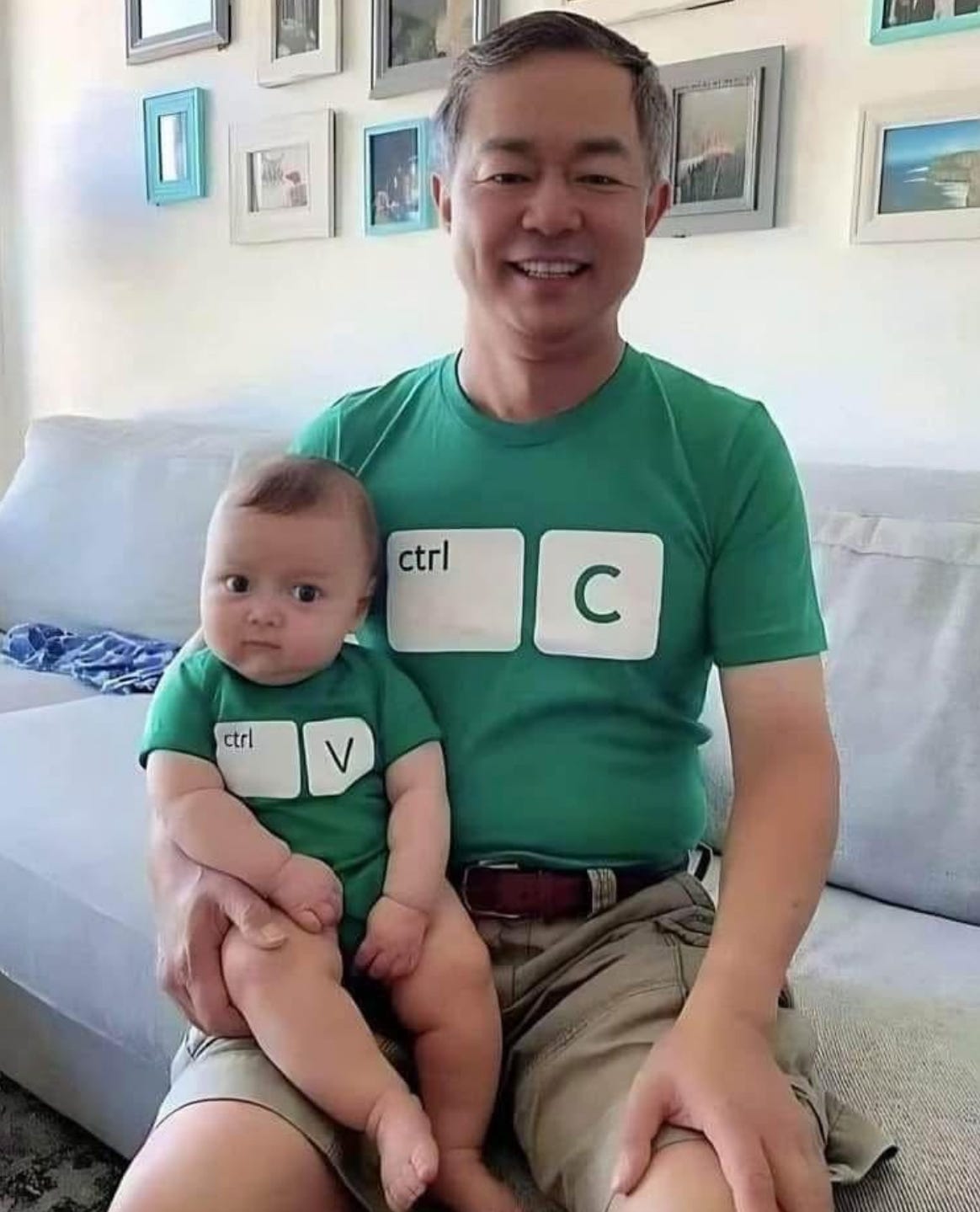
In Tuesday’s paid-subscriber editions, I present my favorite tweets that rely on visual humor. Subscribers then vote for their favorite. Here is the winner from this week’s contest:
The new nominees for Quip of the Week:
If you drink enough, any bar can be a karaoke bar. — @KevinBuffalo
Do you ever think about how Japanese dogs understand Japanese and you don't? — @citizenkawala
Got pulled over today and the cop asked if I know why he pulled me over. I replied, "Is it because you want to see how tall I am?" He said, "Step out of the car sir." See, I knew it. — @ThePunnyWorld
Weddings should have a slide show of the couple’s exes and all the guests get to boo and throw bottles at the screen. — @CasualThursday
Don’t chew your food. It shows weakness. — @poutinesmoothie
One of the weirdest things about mid-century media is that TV used to just stop for the night. They'd put up a graphic that said, in effect, “No more TV, go to bed." And that was it. You didn’t even have a phone to look at. You had to read a book or something. — @looksbizarre
People who take naps are the real heroes. It takes courage to wake up twice in one day. — unknown
Having too much sex can cause memory loss. I read that on page 14 in a medical journal on Nov 14, 2019 at 3:19 p.m. — @Dadsaysjokes
I never chose to love classic rock. When I hit a certain age, it chose me. — @Brock_Teee
Everybody is mad at me due to my infuriating ways. — @donni.bsky.social
Vote here and check the current results in the poll.
For instructions and guidelines regarding the poll, click here.
Why the new name for this feature? See “I’m rebranding ‘Tweet of the Week’ in a gesture of contempt for Elon Musk.”
Minced Words
Cate Plys, Brandon Pope and I joined host John Williams on this week’s episode of “The Mincing Rascals” podcast. We discussed the U.S. Justice Department’s civil rights investigation into Mayor Brandon Johnson, the “pop-up” curfew idea and other topics in the news.
Recommendations:
John: “Theater Kid: A Broadway Memoir” by Jeffrey Seller, producer of “Hamilton” and “Rent”
Cate: Reruns of “Cheers” and “Barney Miller”
Eric: The Colorado Rockies baseball team, for reasons explained below
Subscribe to us wherever you get your podcasts. Or bookmark this page. If you’re not a podcast listener, you can hear an edited version of the show at 8 p.m. most Saturday evenings on WGN-AM 720.
Read the background bios of some regular panelists here.
Good Sports
Greetings from Caitlinville
Picayune Sentinel video
The Picayune Sentinel had nosebleed seats for last Saturday’s WNBA game between the Chicago Sky and the Indianapolis Fever. As you can see from my iPhone video of the introduction of Fever superstar Caitlin Clark, Gainbridge Fieldhouse was rockin’.
Clark didn’t disappoint. She led her team to a 93-58 trouncing of the Sky, was in double figures for points, assists and rebounds, and provoked a chippy altercation with her rival, Sky center Angel Reese. Clark was called for the lowest level of flagrant foul, which looked right to me, as there was a little extra, gratuitous oomph in how she hacked at Reese to prevent her from making an easy layup.
I’m sure Reese isn’t alone among WNBA players in resenting the attention and endorsement money that Clark is getting, and that may have fueled her fury at the way Clark fouled her. But Clark is really fun to watch with her clever passing and long-range bombs. Her success — I’d estimate that at least 5,000 of the more than 17,000 fans in attendance were wearing Clark apparel of some sort — is well deserved. The league needs her.
That said, I hope there’s nothing to the reports that fans courtside heckled Reese with racist remarks after the altercation. The league emphatically does not need that.
Rockiest start ever
Wednesday night’s loss to the Philadelphia Phillies left the hapless Colorado Rockies with a record of 8-41, assuring that they will set the mark for the worst record after 50 games in modern MLB history. That record was set by the 2023 Oakland A’s, who were 10-40 after 50 games.
The White Sox now stand at 15-35, exactly where they were last year at this point when they went on to set the modern record for losses in a season with 121.
The 2023 A’s rallied, after a fashion, to finish 50-112.
It’s ain’t over ‘til it’s over
I’ve been watching a lot of the NBA playoffs this year, but mostly just the last few minutes of each game (and only when they’re close). The first 45 minutes or are often meaningless ground pawing. True fans scorn my approach, but I felt vindicated Wednesday night when the Indiana Pacers came back from a 14-point deficit with 2:40 left in the first game of the Eastern Conference finals against the New York Knicks to tie it in regulation and then win in overtime.
Green Light
Green Light features recommendations from me and readers not only of songs — as in the former Tune of the Week post — but also of TV shows, streaming movies, books, podcasts and other diversions that can be enjoyed at home — i.e., no restaurants, plays, theatrical films, tourist sites and so on. Email me your nominations, and please include a paragraph or two of explanation and background along with helpful links, perhaps including excerpts from reviews or background articles. For TV shows, please include links to trailers/previews on YouTube and advice on where to stream them. This week’s Green Light is from Scott Tepper:
Many years ago, I dated someone from another country for a few weeks. We had a good time together, but in the end, we weren't a match. Yet I came away from that time with something that was much more lasting. He introduced me to the music of Eva Cassidy.
I had never heard of her. Apparently she had much more of a following outside of the U.S. But after hearing two of her songs, I had to go out and buy all the CDs (you can tell this was a while ago), that I could find that she had made.
Sadly, she wasn't able to make many albums. She passed away from cancer in 1996 at age 33.
When I have mentioned her to other people, no one seems familiar with her.
Her voice is unique in her range, clarity, and precision. Her ability is almost like a magic trick ... what she does with softness, held notes, and clarity seems simple, but is actually very difficult and rare.
It's so sad that she passed at such a young age, and that more people are not familiar with her. The amount of joy her songs have given me over the years is immeasurable.
I hope her music brings some joy to you.
Among the links Tepper sent along was Cassidy’s cover of Sting’s 1993 song “Fields of Gold.”
You'll remember me when the west wind moves
Upon the fields of barley
You can tell the sun in his jealous sky
When we walked in fields of gold
Other Cassidy covers he sent along were “Songbird” and “Over the Rainbow,” the latter being the recording that elevated her to posthumous fame and was featured in this 2001 feature on ABC’s “Nightline.”

Info
Eric Zorn is a former opinion columnist for the Chicago Tribune. Find a longer bio and contact information here. This issue exceeds in size the maximum length for a standard email. To read the entire issue in your browser, click on the headline link above. Paid subscribers receive each Picayune Plus in their email inbox each Tuesday, are part of our civil and productive commenting community and enjoy the sublime satisfaction of supporting this enterprise. Browse and search back issues here.
Contact
You can email me at ericzorn@gmail.com or by clicking here:
I read all the messages that come in, but I do most of my interacting with readers in the comments section beneath each issue.
Some of those letters I reprint and respond to in the Z-mail section of Tuesday’s Picayune Plus, which is delivered to paid subscribers and available to all readers later Tuesday. Check there for responses.
If you don’t want me to use the full name on your email or your comments, let me know how you’d like to be identified.
Social media
Facebook: https://www.facebook.com/ejzorn
Twitter: https://x.com/EricZorn
Threads: https://www.threads.net/@ejzorn
Help?
If you’re having troubles with Substack — delivery, billing and so forth — first try “Picayune Sentinel Substack help, Frequently Asked Questions.” If that doesn’t work check out the Substack help page. And if that doesn’t work, shoot me an email and I’ll be happy to help.
Thanks for reading!
The disgraceful ambush of President Cyril Ramaphosa, who showed great dignity and restraint, by the racist liar-in-chief is another orange stain on the international reputation of the US.
I have noticed that the media has taken to referring to white South Africans as "AfrIkaners," when the Afrikaners are those white South Africans of Dutch descent who speak Afrikaans (a Dutch-related language) and do not include those of British, French, etc., descent. Though the apartheid (a Dutch word meaning, essentailly, segregation) regime was led by Afrikaners it profited all white South Africans who, as the fruits of racism and colonialism, own 70% of the land while being about 10% of the population.
So, Kristi "Puppy-Killer" Noem appeared before the Senate homeland security committee Tuesday, and it didn't go so well for her. From claiming voters "overwhelmingly" voted for more border security (Trump won a plurality by 1.5 points in 2024 - not exactly a landslide) to trying to defend illegal expenditures for their mass deportation program, she made a complete fool of herself.
But by far her dumbest moment came when she was asked to define habeas corpus: "Habeas corpus is a constitutional right that the president has to be able to remove people from this country."