
Murder, I wrote
& yes, academics have found that "Bear weather" is a thing


1-15-2026
This week:
News and Views — Hot takes, fully baked
WTF — In which I try to keep up with the horrifying news from the White House
Land of Linkin’ — Where I tell readers where to go
Squaring up the news — Where Charlie Meyerson tells readers where to go
Media notes — Did Scott Adams find Jesus before he died, or was he just saying so?
Quotables — A collection of compelling, sometimes appalling passages I’ve encountered lately
Music will be able to unlock your memories when you don’t have many memories left — So plan ahead!
Quips — The winning visual jokes and this week’s contest finalists
Good Sports — Is “Bear weather” even a thing?
Green Light — “Alternate Realities,” a podcast series about a son’s effort to pry his father away from loony conspiracy theories
Sorry, wing nuts, but Renee Good was straight up murdered by ICE
Longtime readers will know that I don’t immediately rush to the partisan ramparts after a controversial killing. I do my best to examine each situation in granular detail — moment by moment or, when possible, frame by frame — and then call ’em like I see ’em.
My friends on the political left are sometimes aghast at my conclusions. For instance, after taking the closest possible look at all the circumstances and evidence, I argued that George Zimmerman was justified in shooting Trayvon Martin in 2012, that Kyle Rittenhouse was justified in opening fire on those who attacked him on the streets of Kenosha in 2020 and that Chicago police Officer Eric Stillman simply made a ghastly but understandable mistake when he shot and killed Adam Toledo in the Little Village neighborhood in 2021. Some of these friends have yet to forgive me.
I point out to these critics that a similarly close look prompted me to condemn Chicago police Officer Jason Van Dyke for shooting and killing Laquan McDonald in 2014, that off-duty Chicago police Sgt. Khalil Muhammad lied when he claimed to have had a good reason to shoot Ricardo Hayes in 2017 and that police clearly lied about their reasons for pulling over Dexter Reed in 2024 in a traffic stop that ended with Reed dying in a shootout.
I hope that this preamble lends some nonideological credibility to my conclusion that Immigration and Customs Enforcement (ICE) agent Jonathan Ross had no valid reason to open fire on Renee Good in Minneapolis on Jan. 7, and there is no other word for this appalling execution than murder.
All you really need to see are these two images, grabbed from an analysis of the video conducted by The New York Times:
This is the moment the first of three shots was fired at Good. Note first the position of Ross’ feet at the moment he fired, highlighted in the white box:

Simultaneously, note that the wheels on Good’s SUV were turned to the right, away from Ross.

Though Ross couldn’t see the wheels, the SUV was inclining away from him and not going to run him over, as he wasn’t in the vehicle’s path. At worst, the car would have clipped him at slow speed or knocked him with the mirror.
And how was shooting the driver going to prevent that? Those who are minimizing the horror of this incident have claimed that Ross was firing in self-defense, but killing a driver behind the wheel of a car that you think is about to run you over would not instantly stop the car and only make it more likely that the wounded or dead driver, foot on gas, would careen down the road (as Good’s SUV did) and strike innocent bystanders (as Good’s SUV thankfully did not).
From the Times:
President Trump and others said the federal agent was hit by the SUV, often pointing to another video filmed from a different angle. And it’s true that at this moment, in (the) grainy, low-resolution footage, it does look like the agent is being struck by the SUV. But when we synchronize it with the first clip, we can see the agent is not being run over. In fact, his feet are positioned away from the SUV.
Index Investigation posted frame grabs of when Ross fired his wholly gratuitous second and third shots:

The first shot may have been the fatal shot, but even still, these extra shots — when no one can argue that Good was a threat to Ross — suggest the same out-of-control mindset that caused Jason Van Dyke to fire 16 times at Laquan McDonald.
“The reality is that his life was endangered, and he fired in self-defense,” Vice President JD Vance said.
Good “violently, willfully, and viciously" ran over an ICE officer, President Donald Trump said.
“People need to understand that there’s an ICE officer standing directly in front of the car when it starts to accelerate,” U.S. Rep. Tom Emmer, R-Minnesota, said.
“It sure as heck looks like this is an act of domestic terrorism by this woman trying to run over a federal agent, and he was acting out of self-defense,” Rep. Derrick Van Orden, R-Wisconsin, said.
That is horseshit. All of it. Obvious, malodorous, steaming horseshit.
And as for the claim advanced this week by the Department of Homeland Security that Ross experienced “internal bleeding” after the incident, I would say first that DHS’ claims have zero credibility with me, and I will need to see medical records before believing that this alleged injury was remotely serious. And second I wonder where all those on the right now wringing their hands and donating money in sympathy with Ross were when their mobs were attacking Capitol Police officers on Jan. 6, 2021.
Renee Good was trying to get away from the goons who were swearing at her and reaching toward her car. She was not, for the record, blocking traffic on Portland Avenue — in the videos, we see cars driving around her SUV, which was parked perpendicular to traffic in a way that impeded but did not stop the flow of cars.
If only we had a Justice Department and an FBI we could trust, and if only they were cooperating with local law enforcement officials instead of freezing them out of their bogus “investigation.”
What Good was doing with her protest was provocative and ineffective. Federal agents had every right to force her to move her car and to arrest her if she refused to move. But they had no right and no reason — none — to shoot her dead.
If anyone wants to offer a contrary interpretation of the video evidence, let’s hear it.
Here’s what federal law enforcement guidelines say
From Section VI B-2 of the February 2023 update to the Department of Homeland Security’s use of force guidelines:
(Department of Homeland Security law enforcement officers) are prohibited from discharging firearms at the operator of a moving vehicle, vessel, aircraft, or other conveyance unless the use of deadly force against the operator is justified under the standards articulated elsewhere in this policy.* Before using deadly force under these circumstances the LEO must take into a consideration that hazards that may be posed to law enforcement and innocent bystanders by that of control conveyance
*If the suspect threatens the officer with a weapon or there is probable cause to believe that he has committed a crime involving the infliction or threatened infliction of serious physical harm, deadly force may be used if necessary to prevent escape, and if, where feasible, some warning has been given.
From the U.S. Department of Justice Policy On Use Of Force Section 1-16.200
Law enforcement and correctional officers of the Department of Justice may use deadly force only when necessary, that is, when the officer has a reasonable belief that the subject of such force poses an imminent danger of death or serious physical injury to the officer or to another person. Deadly force may not be used solely to prevent the escape of a fleeing suspect. …
Firearms may not be discharged at a moving vehicle unless: (1) a person in the vehicle is threatening the officer or another person with deadly force by means other than the vehicle; or (2) the vehicle is operated in a manner that threatens to cause death or serious physical injury to the officer or others, and no other objectively reasonable means of defense appear to exist, which includes moving out of the path of the vehicle. …
Officers will be trained in de-escalation tactics and techniques designed to gain voluntary compliance from a subject before using force, and such tactics and techniques should be employed if objectively feasible and they would not increase the danger to the officer or others. When feasible, reducing the need for force allows officers to secure their own safety as well as the safety of the public.
From U.S. Customs and Border Protection’s use of force policy, Chapter 1-C-2
Authorized Officers/Agents should avoid standing directly in front of or behind a subject vehicle. Officers/agents should not place themselves in the path of a moving vehicle or use their body to block a vehicle’s path. Authorized Officers/Agents should avoid intentionally and unreasonably placing themselves in positions in which they have no alternative to using deadly force.

Last week’s winning quip
You misunderstood. When I said, “Let’s circle back to that in the new year” I meant “Never contact me again.” — @ohnoshetwitnt.bsky.social
Here are this week’s nominees and the winner of the Tuesday visual-jokes poll. Here is the direct link to the new poll.

News & Views
News: Chicago is considering selling sponsorships and naming rights at O’Hare International and Midway airports.
View: Oh, why not? The city is “inviting potential sponsors to describe their interest in sponsoring a range of airport assets, including parking lots, elevators, family restrooms and airport shuttle buses and stops.”
Sure, the airport will start looking like the logo-covered fire suits worn by race car drivers, but if it can stave off tax increases, I’ll allow it.
News: Indiana weighs legislation to allow executions by firing squad.
View: I’m opposed to the death penalty, but I see nothing particularly wrong — cruel or unusual — about this quick method of dispatching condemned prisoners. For reasons I’ve never understood, lethal injection drugs are expensive and often hard to obtain, but veterinarians manage to humanely euthanize large animals all the time. Additionally, lethal injections have the highest “botch” rate of any common methods, according to this table posted by the anti-capital punishment site the Death Penalty Information Center.
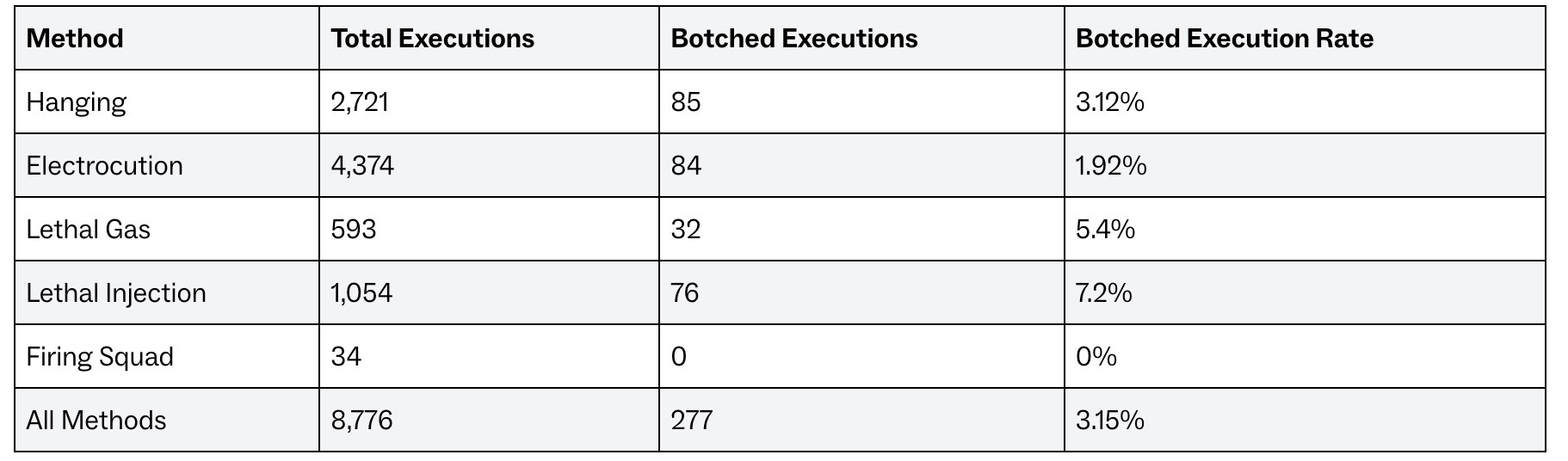
The site notes that the research from which these figures were generated did not take into account two botched firing-squad executions on record, both in Utah, one in 1951 and the other in 1879.
Is a firing squad execution unseemly, disturbing, even a bit revolting? I think so. But should capital punishment be sanitized and made to seem dignified and serene? No. I think the public should be able to witness the act being performed in its name.
News: California Democratic Gov. Gavin Newsom is campaigning against a proposed wealth tax.
View: Newsom’s contention that imposing extra taxes on the rich will cause so many of them to leave California altogether that it will cost the state in the long run may well be valid. But if he runs for president in 2028, it will likely not endear him to Democratic primary voters, who largely favor asking the rich to kick in more. From The New York Times (gift link):
The initiative would require Californians with a net worth beyond $1 billion to pay a one-time tax equal to 5 percent of their assets. It would apply retroactively to anyone who was living in California as of Jan. 1. … California’s nonpartisan legislative analyst and the governor’s Department of Finance said in a joint review that the tax would probably deliver tens of billions of dollars in one-time money for the state, but that it could lead to hundreds of millions or more in continuing losses from billionaires leaving California to avoid the tax. …
California’s state budget relies heavily on high earners, who, under the state’s progressive tax structure, pay most of the state’s income taxes. … The governor defended the state’s progressive income tax as a righteous approach. But he said a wealth tax, which taxes assets instead of income, was “something very, very different.”
My heart says yes. Come on, billionaires, how much money do you really need? But my head says Newsom probably has a point.
Wow, that’s Fouled Up (or WTF)
“Trump says anything less than U.S. control of Greenland is ‘unacceptable.’”
“FBI searches home of Washington Post journalist in a leak investigation “
“US will suspend immigrant visa processing from 75 countries over public assistance concerns.”
“Trump Again Threatens To Withhold Federal Funding To Sanctuary Cities Including Chicago”
The Trump Administration is employing white nationalist slogans in its social media posts, such as “ One homeland, one people, one heritage. Remember who you are, American.” Meanwhile Elon Musk endorsed with the ‘100’ emoji a message on Twitter that read "If white men become a minority, we will be slaughtered. White solidarity is the only way to survive."
“Trump administration sends letter wiping out addiction, mental health grants.” UPDATE: Restored!
Land of Linkin’

A pair of worthy articles in Chicago Magazine: Bob Chiarito’s “Revisiting City News Bureau, Chicago’s Trusted Agency” about a new book detailing “how CNB broke stories for more than a century.” And Edward Robert McClelland’s “Who Will Be Chicago’s Next Mayor?” in which he ranks the potential field of hopefuls in the 2027 race.
Bingo Baker is a free site where you can generate your own bingo cards for, say, a sporting event, the news of the year, words used in a presidential speech, a mayoral news conference and so on.
WGN-AM midday host John Williams has posted a reader poll asking us to help select the best “speed joke” from 2025. It’s now down to the final four. Williams began during the pandemic, lightening his daily broadcasts with a series of quick chuckles, and five years later he’s still at it.
Billionaire Bill Ackman donated $10,000 to the defense fund of Jonathan Ross, the ICE agent who killed Renee Good in Minneapolis, but this Newsweek article explains why Ackman’s support of Ross is not a reason for consumers to boycott Chipotle, a restaurant chain in which Ackman was once an investor but is no longer.
In “Trump’s Offensive Against the Fed Chair Is About Acquiring Limitless Power for Retribution,” Steve Chapman writes, “Trump wants every American to fear the consequences of challenging him. The hope is that Powell and the Fed can survive Trump’s assault, and that Congress or the Supreme Court will finally put limits on his reckless use of power. If not, we will all have reason to be very afraid.”
“Asking ChatGPT for Medical Advice? Here’s How to Do It Safely.” (New York Times gift link). One physician “recommended asking the chatbot to ‘summarize what you know about my medical history’ at regular intervals. Such check-ins can help correct misunderstandings and make sure the chatbot stays on track.”
A reminder that the myth-busting site Snopes is among the first places to check when you hear or read a story that makes your blood boil (or confirms your biases).
In case you missed it: “The top 40 quips of 2025” includes links to the top quips of the year as well as those going back to 2015.
Jon Stewart’s monologue on “ICE’s Killing of Renee Good and Trump’s Model of Compliance for Protesters.”
A week ago, I posted a write-up of my father’s final hours that many of you responded to positively. Here is a link directly to that item. And here is a link to my post on Tuesday about the common expression of condolence, “May his/her memory be a blessing.” Finally, some people have asked if there’s an online archive of my late father’s work in sculpture, and it turns out that, yes, there is!
“Horses. Don’t like ‘em” is a recent post from the very odd Twitter account, “Horse Hater.”
My opinion of Bears head coach Ben Johnson’s dropping of several f-bombs on the Packers on Saturday night is not particularly popular with PS readers. You get a chance to vote if you click through.
Squaring up the news
This is a bonus supplement to the Land of Linkin’ from veteran radio, internet and newspaper journalist Charlie Meyerson. Each week, he offers a selection of intriguing links from his daily email news briefing Chicago Public Square:
■ The Associated Press fact-checks Trump on Greenland.
■ Ready to declutter? One5c has guides for responsibly disposing of old clothes, spent electronics, used-up batteries, mushy mattresses and more.
■ Platformer’s Casey Newton: “What I learned while cloning my own voice”—to create an audio version of his columns. (Here is the AI-cloned version of that post.)
■ If ICE stops you on the sidewalk and asks, ‘“Are you a U.S. citizen?: Lawyer and columnist Mitch Jackson says you have the right to ask one clarifying question: “Am I free to leave? If the answer is yes, you walk away calmly. Don’t say another word.”
You can (and should) subscribe to Chicago Public Square free here.
Media notes
The Tribune’s Rick Pearson offers a fond remembrance of former Tribune Springfield bureau chief Dan Egler, who died Jan. 5 at age 78.
On Monday, Jan. 26, at 6:45 p.m., WGN-TV will launch “The Point,” a nightly show hosted by the station’s political editor Tahman Bradley. The show “will give viewers direct access to elected officials, candidates for office, senior aides/strategists and interesting voices.”
Before he died Tuesday at 68, “Dilbert” cartoonist Scott Adams left a message for those who had been urging him to convert to Christianity: “I'm not a believer, but I have to admit the risk-reward calculation for doing so looks so attractive to me. So here I go: I accept Jesus Christ as my Lord and Savior and look forward to spending an eternity with him. The part about me not being a believer should be quickly resolved if I wake up in heaven. I won't need any more convincing than that. I hope I'm still qualified for entry.”
Quotables
A collection of compelling, sometimes appalling passages I’ve encountered lately
The assault against Venezuela and the potential conquest of Greenland sprout from the same impulse prompting all totalitarians to engage in wars — as stunts, peacock preening and macho shows of power, to justify repression at home, turning protest into disloyalty and to distract from internal failures. — Neil Steinberg
Listen to them. They are telling you what they are, what they want to do. It’s not just trolling. They are reciting fascist slogans, filling the streets with heavily armed masked agents, and preparing to make the 2026 midterms into a nationwide Jan 6. — Garry Kasparov
It didn’t start with gas chambers. It started with one party controlling the media. One party controlling the message. One party deciding what is truth. One party censoring speech and controlling the opposition. One party dividing citizens into “us” vs, “”them” and calling on their supporters to harass “them.” It started when good people turned a blind eye and let it happen. — unknown
Undocumented migrants can always hide in the Kennedy Center, no one will find them there. — Thelma Johnson
Absolutely incredible that people worried about government overreach and “weaponization” of the legal system endorsed Trump. Just the biggest group of dunces. — Charlie J. Johnson


Plan ahead: Make a playlist for your dotage
The important role that music and song played in my interactions with my father right up until his recent death prompts me to renew a suggestion I made in 2019: Go to your favorite online search engine and type in “Top 100 songs of” and add the year you turned 10.
Scan the list that pops up. Make note of the songs that stir you in some way, that conjure up a specific feeling or person, incident or time in your life.
Don’t necessarily pick out cool or sophisticated songs by artists who have stood the test of time — you were 10, come on! Unashamedly select what was actually in the soundtrack of your life back then.
For example, my list from 1968 includes “Love is Blue” by Paul Mauriat, “The Ballad of Bonnie and Clyde” by Georgie Fame and the Blue Flames and “This Guy’s in Love With You” by Herb Alpert. Not that I love these songs today. In fact, I actively disavow Alpert’s most saccharine efforts. But they and many others take me back, instantly and vividly, to moments, people and places that otherwise seldom come to mind.
Repeat for your 11-year-old self, your 12-year-old self, up until your present-day self. Go earlier if you were a precocious listener. Expand your search into non-pop genres you’ve enjoyed — I’m not big into classical, but Joseph Haydn’s Trumpet Concerto in E-flat major (1796) has mysterious yet strong associations with my great high school love affair (1976).
Even if you’re no longer an avid listener to music, chances are you’ll still resonate with at least a few unavoidable and sometimes musically excruciating songs every year. As long as the memories are pleasant, don’t sweat the quality.
You will find it, I promise, a pleasant assignment.
The purpose, however, is somewhat grim.
It’s to create a playlist for your future self experiencing cognitive decline.
You might not need it. The Institute for Dementia Research & Prevention at Louisiana State University reports that 1 in 6 women and 1 in 10 men who live past 55 will develop a form of dementia (of which Alzheimer’s disease is the most common) before they die of other causes.
But if you do begin to experience the profound memory losses associated with aging, research has shown that music can ease the journey into oblivion. Put the songs of your life on shuffle, and the days are a little less long, the hours a little more pleasant.
I adapted this idea from psychiatrist and bioethicist Tia Powell, 62, who includes it in her new book, “Dementia Reimagined: Building a Life of Joy and Dignity from Beginning to End.”
“The capacity to enjoy and respond to music outlasts many other cognitive functions; even after spontaneous speech has become difficult, many people can still sing lyrics to songs learned long ago,” Powell writes. So “I’m going to go ahead and make my playlist now, to help me picture being happy, even with dementia.”
Her list includes “I’ll Take You There” by the Staple Singers, “Brick House” by the Commodores and “You Can Close Your Eyes” by James Taylor, which she notes was a favorite lullaby for her youngest daughter.
Your playlist will “help you look back over your life, collect a few moments of joy — or even sorrow — to bring forward to the future, for a time when it won’t be easy for you to look back,” writes Powell, whose mother and grandmother both died after losing most cognitive function. “It will be your gift to yourself with dementia. A small gift, I admit, in the face of a big problem.”
Powell notes that she bases this recommendation on the work of Dan Cohen, a social worker who in 2008 founded Music & Memory, a New York City-based nonprofit dedicated to providing personal digital music players to elderly residents of assisted living and long-term care facilities.
Cohen began by collecting used iPods and helping residents of a nursing home create their personal playlists. This can be a hit-and-miss proposition when trying to tap into the emotional memories of those who in many cases have few actual memories left and have lost the ability to speak.
That’s why it makes sense to make your own list before any major decline sets in — think of it as a musical will and keep it with your other vital papers.
Songs won’t cure anyone or meaningfully arrest the slide of the disease, but research has shown it may diminish emotional distress and behavioral problems in patients, lower their blood pressure and even improve swallowing.
The concept of MEAMs — music-evoked autobiographical memories — is well known in psychology. Certain pathways in the brain are sometimes accessible only via music and seem to be detours around conventional pathways that age has closed.
“Music is a back door to the mind,” said the late neurologist and author Oliver Sacks in “Alive Inside,” a 2014 documentary about Cohen’s work. The film shows nearly catatonic elderly people responding to musical stimulation as though animated by a power switch.
“Dementia Reimagined” author Powell said in a phone interview back in 2019 that music may not recover actual, vivid memories in the biologically ravaged minds of dementia patients.
“Some people may sit up when they hear a song and say, ‘Oh, I danced to this at my wedding!’” she said. “But music’s access to memory is probably not that literal. It’s more likely that it acts in some visceral, emotional way that simply makes them feel happy. We definitely know it provides moments of joy, which is in short supply.”
Powell said her purpose in suggesting the idea of advanced-directive end-of-life playlists was similar to the overall purpose of her book — to persuade readers to incorporate into their terror of this sad, terrifying and incurable condition the idea that, with proper foresight, there can still be “a bit of pleasure” in the lives of those living with dementia.
If finding those bits of pleasure will involve plugging into sappy, corny, trite music you’d be embarrassed to be caught listening to today, don’t worry. If the dignity of your legacy demands it, instruct your heirs to burn your playlist after your demise.
But make it now.
Quips
In Tuesday’s paid-subscriber editions, I present my favorite tweets that rely on visual humor. Subscribers then vote for their favorite. Here is the winner from this week’s contest:

The new nominees for Quip of the Week:
Another term for mansplaining is “correctile dysfunction.” — unknown
I wonder if Einstein’s friends were ever able to say “nice one, Einstein” without sounding sarcastic. — @granttanaka.bsky.social
I rely on my daily meditation practice to quiet my mind and judge people who don’t meditate. — @itsabbyyep.bsky.social
I’ve never been in denial and I never will be. — @jakevig.bsky.social
I got fired from my job because I kept asking my customers whether they would prefer “smoking” or “non-smoking.” Apparently the correct terms are “cremation” and “burial.” — @ThePunnyWorld
I bet just once he’d like to hear, “Sure thing, Jose.” — @benedictsred
Should auld acquaintance be forgot and never brought to mind? Experts say it’s not so simple. — @dwbond.bsky.social
It’s not easy worshipping the devil. I’ve had to make a lot of sacrifices. — @wildethingy
ME: I trained this chicken to talk. HER: Let’s see. ME: What’s a male deer? CHICKEN: Buck! ME: How much is 200 pennies? CHICKEN: Buck! Buck! HER: This is stupid. ME: It’s gets better. CHICKEN: Yes, it gets way better. — @Mariana057
“This is the best thing since sliced bread!” … first person to use toilet paper. — @craiguito.bsky.social
Vote here and check the current results in the poll.
For instructions and guidelines regarding the poll, click here.
Minced Words
Cate Plys, Austin Berg and I joined host John Williams on this week’s episode of “The Mincing Rascals” podcast. We traded views on —
Bears coach Ben Johnson dropping the f-bomb on the Packers in a viral video.
The new online ad from Republican gubernatorial hopeful Ted Dabrowski in which he blames Gov. JB Pritzker for the death of Katie Abraham, a 20-year-old Glenview woman killed by an undocumented Ecuadorian immigrant who was driving drunk.
Sanctuary cities.
Austin’s Washington Post column this week, which was a version of his recent Substack post, “Why you can’t start a Chicago-style hot dog cart in Chicago.”
Traffic lights:
John — A green light for “Song Sung Blue,” the Hugh Jackman/Kate Hudson film about a Neil Diamond interpreter. In theaters.
Austin — A green light for “No Other Choice,” a dark comedy. In theaters.
Cate — A green light for tiny alarms that you attach to your refrigerator to alert you if you’ve left the door open.
Eric — A green light for “Alternate Realities,” a podcast series highlighted below.
Subscribe to us wherever you get your podcasts. Or bookmark this page. If you’re not a podcast listener, you can hear an edited version of the show at 8 p.m. most Saturday evenings on WGN-AM 720 or look for the YouTube version that will be posted Friday.
Read the background bios of some regular panelists here.
Good Sports
Bear weather. Is it a thing?
The weather forecast for Sunday night’s Rams-Bears playoff game at Soldier Field calls for a chance of snow along with wind chills hovering near 6 degrees. Locals like to call such frigid temps “Bear weather” based on the idea that our players are made of sterner stuff than players on teams that play nearly all their games in warmer climes or domes.
Bears coach Ben Johnson seems to agree, saying, “I like the cold. I do like the cold,” and adding that “this will be the coldest game that (the Los Angeles Rams) have played this year.”
Sports Illustrated said it could find no evidence for “Bear weather” being an advantage in a 2012 article:
After studying data from every NFL game from every season since 1985 -- more than 6,000 games -- and matching the results to the outside temperature, wind, rain and snow conditions, we’ve found that cold-weather teams are no more likely to win at home when the weather is brutally cold. Nor are warm-weather teams more likely to win at home when the temperature is ruthlessly hot. … Averaging across all cold and warm weather teams over the last 25 years, there is little to no unusual effect on performance. Contrary to conventional wisdom, weather imbues a team no additional home advantage.
But a 2020 analysis posted to the College Sports Madness blog came to a different conclusion:
Pro-Football-Reference data indicated that points scored steadily decrease with temperature … (but) that the drop in points affected the home and road teams differently. Home teams handled the weather better than the road teams. This leads to the conclusion that cold weather games hold a significant advantage for the home team.
And peer-reviewed research published in 2021 in the Proceedings of International Mathematical Sciences “left no doubt that cold weather teams have a mathematically significant advantage over all other NFL teams during December, January, and February, and in comparison to all other times of the year.”
Fine line
(Bears/Packers) wasn’t a rivalry, really, as lopsided as it was. This was Alfalfa swinging wildly and fruitlessly at Butch as Butch held him at bay by his head. You know who gets that “Little Rascals” reference? People who were around for the Bears’ previous playoff win against the Packers on Dec. 14, 1941. — Phil Thompson, Chicago Tribune
Schadenfreude opportunity
Block Club Chicago assembled a set of videos of Packer fans apoplectic over their team’s collapse against the Bears on Saturday. Enjoy!
Green Light
Green Light features recommendations from me and readers not only of songs — as in the former Tune of the Week post — but also of TV shows, streaming movies, books, podcasts and other diversions that, with only rare exceptions, can be enjoyed at home.
“Alternate Realities” is a three-part podcast series from NPR in which reporter Zach Mack delves into a rift in his family caused by his father’s belief in numerous right-wing conspiracy theories. For example, his father predicted with 100% certainty that in 2024:
It would be revealed that President Joe Biden has “probably three or four, maybe more” body doubles.
Former President Barack Obama, House Speaker Nancy Pelosi, and Bill and Hillary Clinton would be found guilty of treason.
There would be a one-world government with a one-world currency.
The U.S. would come under martial law.
What do you do when a relative who is otherwise genial and loving becomes a raving kook? Can you bring them back to reality?
Mack gave it a try, and his father fully cooperated in the making of this engrossing but ultimately depressing series, which was part of NPR’s “Embedded “ program. A follow-up episode, titled “Double or Nothing,” posted just last month.

Info
I am a former opinion columnist for the Chicago Tribune. I began publishing the Picayune Sentinel on Sept. 9, 2021, roughly two and a half months after I took a buyout from the newspaper. Find a longer bio and contact information here. This issue exceeds in size the maximum length for a standard email. To read the entire issue in your browser, click on the headline link above. Paid subscribers receive each Picayune Plus in their email inbox each Tuesday, are part of our civil and productive commenting community and enjoy the sublime satisfaction of supporting this enterprise. Browse and search back issues here.
Contact
You can email me at ericzorn@gmail.com or by clicking here:
I read all the messages that come in, but I do most of my interacting with readers in the comments section beneath each issue.
Some of those letters I reprint and respond to in the Z-mail section of Tuesday’s Picayune Plus, which is delivered to paid subscribers and available to all readers later Tuesday. Check there for responses.
If you don’t want me to use the full name on your email or your comments, let me know how you’d like to be identified.
Social media
Facebook: https://www.facebook.com/ejzorn
Twitter: https://x.com/EricZorn
Threads: https://www.threads.net/@ejzorn
Help?
If you’re having troubles with Substack — delivery, billing and so forth — first try “Picayune Sentinel Substack help, Frequently Asked Questions.” If that doesn’t work check out the Substack help page. And if that doesn’t work, shoot me an email and I’ll be happy to help.
Thanks for reading!
Do you remember when people remonstrated with you and accused you of hysterical over-reaction when you compared the current "administration" to the early years of Nazi Germany. Brownshirts beating and murdering people in the streets? Persecution of a despised minority? Involuntary transfer to camps that concentrate and brutalize people? A Department of "Justice" that perpetrates injustice? Government departments openly deploying white nationalist slogans and images? Territorial aggression in search of plunder and Lebensraum? Check, check, check ...
The death penalty, in and of itself, is so barbaric that the method is of less importance than the fact of its existence. And the fact that some of these methods result in further torture of the victim just adds to the barbarity.
I've not been the victim of a crime nor has anyone in my family been a victim so I do not have any insight into the feelings of those who have been. But I have great difficulty imagining that watching someone die at the hands of an executioner would give me relief from my anger and pain.
And as a further objection to executions, the criminal justice system is so terribly flawed that the likelihood that the road to the death room is true and straight is low. From arrest to charging to trials to sentence there is bias and misconduct.
Life sentences are terrible but they offer the possibility of living long enough that correcting the errors in the process. Executions end the opportunity for corrections.